





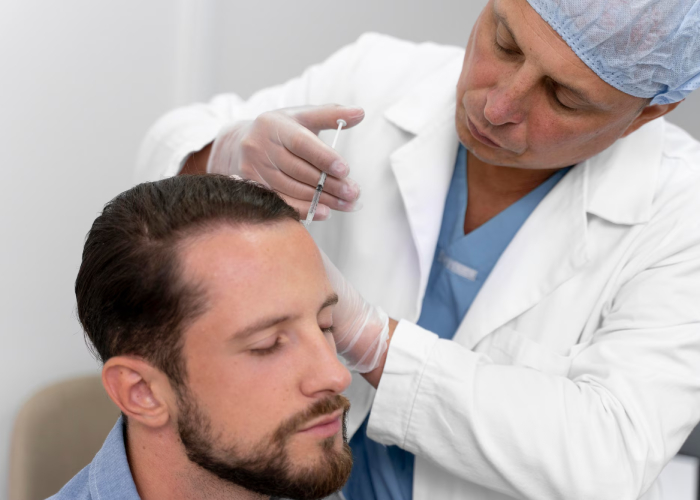
- Restore a youthful, masculine hairline
- Improve density in thinning areas
- Fix bald spots on the crown
- Enhance overall appearance
- Regain confidence and self-esteem
- Achieve permanent, natural hair growth
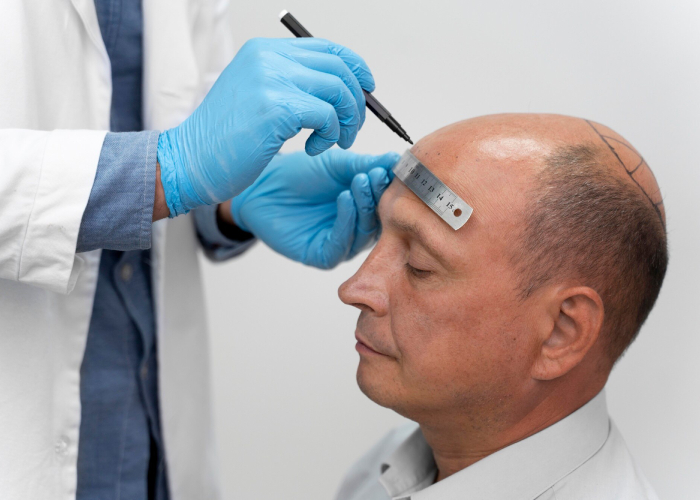
We assess:
- Degree of hair loss (Norwood Scale)
- Donor area strength
- Hairline goals
- Density requirements
- A customized plan is designed for the most natural outcome.
Using micro punches (0.7–0.9 mm), individual follicles are extracted without stitches or visible scars.
3. Hairline Designing
We create a masculine, age-appropriate hairline with natural irregularities.
4. Recipient Site Creation
Micro-channels are made at precise angles and directions to ensure a natural flow of hair.
5. Graft Implantation
Follicles are implanted strategically to achieve:
- High density
- Proper angulation
- Uniform growth
- A soft, natural finish
- Slight M-shaped recession
- Defined yet subtle edges
- Mature positioning (not too low)
- Strong central zone
- Natural blending at the temples
- Permanent & Natural Results Transplanted hair grows for life.
- High Density & Coverage Ideal for receding hairlines and crown thinning.
- No Linear Scar FUE ensures minimal scarring and quick recovery.
- Safe & Minimally Invasive Performed under local anesthesia with advanced tools.
- Boosts Appearance & Confidence Creates a more youthful, refreshed look.
- Suitable for All Stages of Baldness From early thinning to advanced baldness (with proper donor availability).
- Have stable hair loss
- Possess a strong donor area
- Want to restore front, mid-scalp, or crown
- Are looking for a natural, permanent solution
- Have realistic expectations
Is the procedure painful?
No. The procedure is performed under local anesthesia, ensuring you remain comfortable throughout. Most patients describe the sensation as mild pressure rather than pain.
How long does the procedure take?
Depending on the number of grafts required, the procedure typically lasts 6–8 hours. Larger sessions may be scheduled across two consecutive days to maintain graft viability and patient comfort.
When will I see results?
Transplanted hair sheds within 2–4 weeks-a normal part of the growth cycle. New growth begins around the 3rd month, with visible thickening by month 6.
Hair transplant results fully mature between 9–12 months with natural density and texture.
Are the results truly permanent?
Yes. Because transplanted follicles are DHT-resistant, they retain this property.
However, existing non-transplanted hair may continue thinning, which is why we may recommend PRP or GFC therapy alongside your hair transplant.
Will there be visible scarring?
FUE techniques leave tiny, dot-like scars in the donor area that are virtually undetectable, even with short hair. There is no linear scar, making this ideal for patients who prefer buzz cuts or shorter styles.
Can women undergo hair transplantation?
Absolutely. Female pattern hair loss requires a different diagnostic approach and our team is experienced in addressing diffuse thinning, receding hairlines and traction alopecia in women.
What is the recovery time?
Most patients resume non-strenuous work within 3–5 days. Strenuous exercise should be avoided for two weeks. Tiny crusts around grafts fall off naturally within 10–14 days.
How do I know if I'm a suitable candidate?
Ideal candidates have sufficient donor hair, realistic expectations and good general health.
During your consultation, we evaluate these factors thoroughly and discuss alternative or complementary options if hair transplant surgery isn't immediately suitable.


