




- Dull, tired-looking complexion — Caused by slowed cell turnover, accumulated dead keratinocytes, and reduced microcirculation that deprives skin of its natural luminosity.
- Fine lines and early wrinkles — Resulting from collagen depletion (approximately 1% annual loss after age 25), elastin fragmentation, and repetitive facial muscle movement.
- Uneven skin tone and mottled pigmentation — Melanin dysregulation from UV exposure, hormonal shifts, and post-inflammatory responses that create patchy discoloration.
- Rough, irregular texture — Disorganized collagen fibers, enlarged pores, and superficial scarring that disrupt light reflection and tactile smoothness.
- Post-acne marks and superficial scars — Atrophic and hypertrophic changes from previous inflammatory lesions that alter skin topography.
- Solar elastosis and photodamage — UV-induced breakdown of collagen and elastin, visible as deep wrinkles, leathering, and actinic keratoses.
- Enlarged facial pores — Often a consequence of decreased dermal support, excess sebum production, and loss of skin elasticity around follicular openings.
- Loss of elasticity and facial sagging — Weakening of the superficial musculoaponeurotic system (SMAS) and dermal collagen framework.
- Dehydrated, lifeless skin — Reduced hyaluronic acid synthesis, impaired barrier function, and trans-epidermal water loss (TEWL) that leaves skin looking flat and crepey.
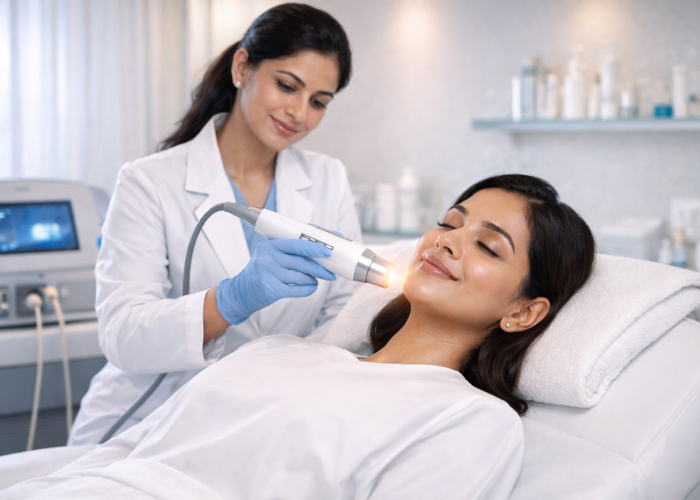
- Fractional & Non-Ablative Laser Resurfacing : Using Nd:YAG 1064nm and erbium-doped modalities, we deliver controlled thermal injury to the dermis in microscopic columns, sparing surrounding tissue. This stimulates wound healing response, collagen type I and III synthesis, and elastin remodeling. Particularly effective for fine lines, acne scars, and photodamage. Parameters are conservative for Fitzpatrick III–V skin to minimize PIH risk.
- Medical-Grade Chemical Peels : Superficial (glycolic 30–50%, salicylic 20–30%, lactic acid 40–60%) for brightening and mild exfoliation; medium-depth (TCA 15–35%, Jessner’s solution) for deeper wrinkle reduction and pigmentation correction; and deep phenol-based peels for severe photodamage. Peel depth is selected based on skin thickness, concern severity, and downtime tolerance.
- Clinical Medifacials (HydraFacial, Brightening, Anti-Ageing) : Physician-directed protocols combining vortex-fusion technology (HydraFacial) with customized serums containing hyaluronic acid, peptides, antioxidants (vitamin C, ferulic acid), and melanin inhibitors. Ideal for maintenance, pre-event preparation, and patients seeking zero-downtime rejuvenation.
- Microneedling with Collagen Induction Therapy (CIT) : Automated dermapen devices create controlled micro-channels (0.5–2.5mm depth) triggering the release of TGF-β, PDGF, and VEGF. When combined with topical actives (vitamin C, hyaluronic acid, growth factors), penetration is enhanced 300-fold. Effective for scars, stretch marks, and overall texture refinement.
- PRP (Platelet-Rich Plasma) & GFC (Growth Factor Concentrate) Therapy : Autologous blood is processed to concentrate platelets 3–5x (PRP) or isolate high-purity growth factors (GFC). These are reintroduced via microneedling or direct injection to accelerate tissue repair, improve vascularization, and stimulate fibroblast activity. GFC offers more standardized, potent growth factor concentrations with fewer sessions required.
- Radiofrequency (RF) Skin Tightening : Monopolar and bipolar RF devices deliver electromagnetic energy to the dermis, causing controlled heating of collagen fibers to 60–65°C. This induces immediate contraction (tissue tightening) and long-term neocollagenesis over 3–6 months. Effective for jawline contouring, neck laxity, and mild to moderate skin sagging.
- Skin Boosters & Mesotherapy : Micro-injections of stabilized hyaluronic acid (Restylane Vital, Belotero Revive), vitamin complexes, amino acids, and antioxidants directly into the dermis. This bio-revitalization improves hydration, elasticity, and dermal thickness without adding volume — ideal for patients seeking natural, subtle rejuvenation.
- Sequential Combination Protocols : For comprehensive rejuvenation, we design phased treatment plans. A typical protocol might begin with a series of chemical peels for surface renewal, followed by fractional laser for deeper collagen remodeling, supported by quarterly PRP maintenance and daily prescription retinoids. This layered approach addresses multiple aging mechanisms simultaneously.
- Phototype-Calibrated Protocols : Every laser parameter, peel concentration, and RF intensity is adjusted for Indian skin’s higher melanin content and elevated PIH susceptibility. Safety is never compromised for speed.
- Multi-Mechanism Anti-Aging : We target collagen synthesis, elastin preservation, barrier repair, melanin regulation, and hydration simultaneously — not just one aging pathway.
- Collagen Quantification : Where available, we use diagnostic imaging to track collagen density improvement, ensuring your investment produces measurable structural change, not just surface glow.
- Zero-Downtime Options : HydraFacial, light peels, and certain RF protocols allow immediate return to professional and social activities.
- Autologous Safety : PRP and GFC use your own biological material, eliminating allergy risk and aligning with our ethical commitment to patient safety.
- Preventive & Corrective : We treat existing damage while establishing protocols that slow future aging — a proactive partnership in long-term skin health.
- Early to moderate signs of facial aging (fine lines, volume loss, textural decline)
- Persistent dullness unresponsive to over-the-counter skincare
- Post-acne atrophic or hypertrophic scarring
- Solar elastosis and actinic damage from prolonged sun exposure
- Enlarged pores and irregular skin topography
- Loss of jawline definition or early jowl formation
- Dehydrated, crepey skin lacking dermal plumpness
- Preventive anti-aging for patients in their late 20s to early 30s seeking to delay collagen depletion
- Visible luminosity and “glass skin” reflectivity after the first HydraFacial or peel session
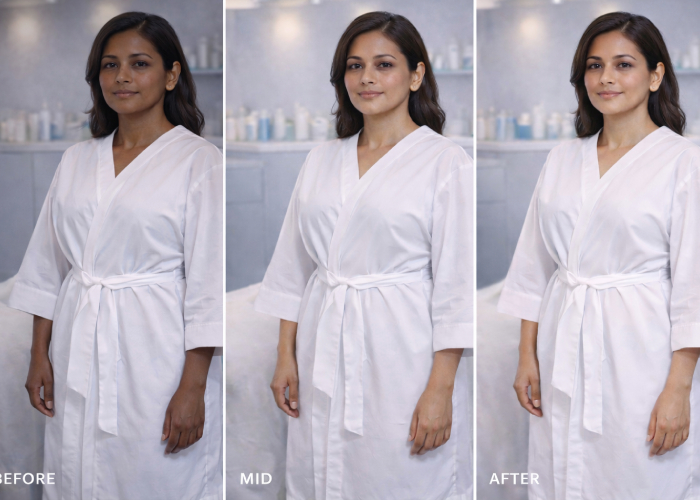
- Progressive smoothing of fine lines and forehead creases over 6–12 weeks of collagen-stimulating therapy
- Measurable reduction in acne scar depth (20–50% improvement after 3–6 microneedling or laser sessions)
- Improved jawline contour and mid-face firmness following RF tightening protocols
- Enhanced skin hydration and elasticity lasting 6–12 months with booster maintenance
- More even pigmentation and reduced mottling after targeted laser and peel sequences
Is skin rejuvenation treatment painful?
Most rejuvenation procedures are well-tolerated with minimal discomfort. Laser and RF treatments may produce a warm or tingling sensation; microneedling involves mild prickling. We apply topical numbing agents before deeper procedures, and our team ensures your comfort throughout every session.
How soon will I see results from skin rejuvenation?
Some treatments like medifacials and HydraFacial deliver immediate glow and hydration visible the same day. Collagen-stimulating procedures such as microneedling, PRP, and laser resurfacing show progressive improvement over 4–12 weeks as new collagen forms. A series of 3–6 sessions typically produces the most noticeable and lasting transformation.
Can skin rejuvenation help with acne scars?
Yes. Microneedling, fractional laser resurfacing, and PRP/GFC therapy are particularly effective for atrophic acne scars. These modalities stimulate collagen remodeling beneath scar tissue, gradually elevating depressed scars and smoothing irregular texture. Deeper boxcar or ice-pick scars may require a combination approach over multiple sessions.
Is laser rejuvenation safe for Indian skin tones?
Absolutely — when performed with appropriate wavelength selection, conservative fluence settings, and cooling protocols. Dr. Chouhan's team has extensive experience treating Fitzpatrick skin types III–V. We use Nd:YAG and erbium-based modalities with parameters specifically calibrated to minimize post-inflammatory hyperpigmentation risk while maximizing collagen stimulation.
What is the difference between PRP and GFC for skin rejuvenation?
PRP (Platelet-Rich Plasma) uses your own blood plasma concentrated to 3–5x baseline platelet levels, releasing growth factors that stimulate repair. GFC (Growth Factor Concentrate) is an advanced, standardized preparation achieving higher growth factor concentrations with more consistent results. Both are autologous and safe; GFC typically requires fewer sessions for comparable outcomes. Dr. Chouhan recommends the optimal approach based on your skin condition and goals.
How long do skin rejuvenation results last?
Results duration depends on the modality and your skincare habits. Surface treatments like peels and facials may last 1–3 months. Collagen-stimulating procedures (microneedling, PRP, laser, RF) can maintain improvement for 12–18 months with proper home care and periodic maintenance sessions. Aging is continuous; we recommend quarterly maintenance to preserve and extend your results.
Can men benefit from skin rejuvenation treatments?
Yes. Men frequently seek rejuvenation for concerns like enlarged pores, shaving-related texture issues, sun damage, and early aging signs. Our protocols are adapted for thicker male skin, higher sebum production, and different facial hair patterns. Treatments are equally effective and popular among male patients at FUE India.
What is the downtime after skin rejuvenation treatment?
Downtime varies by procedure. HydraFacial and light peels have zero downtime — you can resume work immediately. Microneedling and medium peels may cause 24–48 hours of mild redness. Laser resurfacing and deeper chemical peels require 3–7 days of social downtime as the skin heals. Dr. Chouhan will advise the optimal protocol based on your schedule and recovery preferences.


