





Female hair transplant in India requires a fundamentally different approach than male restoration. At FUE India, we understand that women’s hair loss patterns are distinct — often presenting as diffuse thinning across the crown, widening part lines, or temporal recession rather than the predictable horseshoe pattern seen in men. This difference demands specialized diagnostic skill, artistic sensitivity and technical precision that respects feminine aesthetics.
Led by Dr. Vikas Chouhan, our female hair restoration protocol addresses the unique emotional and physical dimensions of women’s hair loss. We recognize that hair is deeply connected to identity, confidence and self-image for women. Our consultations are designed to be thorough, private and supportive — creating a space where you can discuss your concerns openly without judgment.
Unlike male pattern baldness, female hair loss is frequently diffuse, meaning thinning occurs across a broad area rather than in discrete zones. This requires careful donor area management to ensure we preserve density for future needs while achieving meaningful cosmetic improvement. Our approach balances immediate aesthetic goals with long-term hair health.
| Concern | How FUE India Addresses It |
| Widening part line | Strategic graft placement along the part creates the illusion of density without obvious “plug” appearance |
| Diffuse crown thinning | Feathered implantation technique distributes grafts naturally through thinning zones |
| Temporal recession | Soft, curved hairline restoration that frames the face femininely |
| Post-pregnancy shedding | Combines transplant with nutritional and hormonal assessment for comprehensive care |
| Traction alopecia | Targets areas damaged by tight hairstyles, weaves, or extensions |
| Eyebrow thinning | Coordinated brow restoration using the same donor hair for consistency |
Women also seek female hair transplant in India to address hair loss from thyroid disorders, polycystic ovary syndrome (PCOS), menopausal hormonal shifts and autoimmune conditions such as alopecia areata. Our diagnostic process includes assessment of these underlying factors to ensure your treatment plan is medically sound.
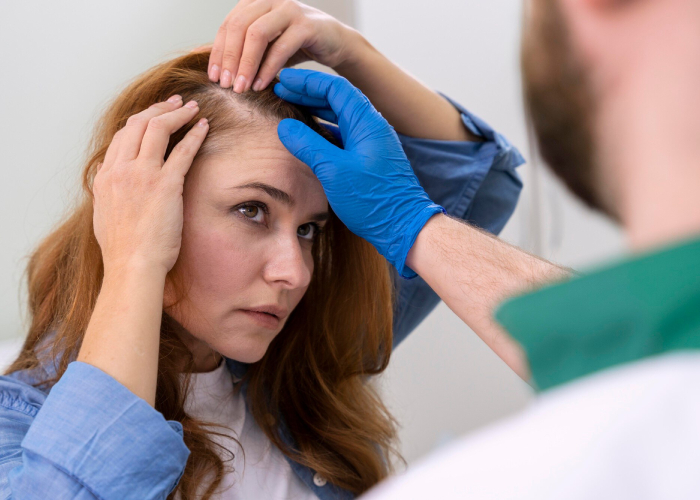
- We begin with digital trichoscopy to map miniaturization patterns and assess donor density. For women, we also evaluate potential contributing factors — hormonal profiles, nutritional status and medical history — because female hair loss is often multifactorial. This thoroughness ensures we don’t transplant into areas where underlying disease may cause continued loss.
- Dr. Chouhan designs a hairline that respects female aesthetics — typically softer, more curved and lower than male standards. Key considerations include forehead proportion, temporal peak placement, frontal tuft preservation and age-appropriate design. The design is reviewed and refined with your input before any extraction begins.
- Women’s donor areas require conservative management. We extract grafts using 0.7–0.8mm punches to minimize any visible change in donor density. The extraction pattern is dispersed widely to avoid creating thin zones that could become noticeable when hair is worn up or pulled back.
- Rather than dense packing, we use a feathered technique — placing grafts at varying densities to mimic natural hair distribution. Single-hair grafts are used at the hairline for softness; 2-hair grafts provide mid-scalp volume. Angulation follows the natural swirl pattern of female hair growth, typically 30–45 degrees from the scalp surface.
- Natural, Feminine Hairline Design: Every hairline is custom-created to complement your facial proportions, ethnicity and age. We avoid the straight, aggressive lines that characterize male restoration, ensuring your result looks authentically feminine.
- No Visible Scarring: FUE extraction leaves microscopic marks that are undetectable, even when hair is worn in a ponytail, bun, or updo. There is no linear scar to conceal.
- Preserves Styling Freedom: Because donor harvesting is dispersed and conservative, you retain the ability to wear your hair in any style — pulled back, short, or layered — without revealing donor-site changes.
- Addresses Diffuse Thinning: Our feathered implantation technique is specifically designed for the diffuse patterns common in female hair loss, creating density that appears natural rather than artificially uniform.
- Comprehensive Care Integration: We coordinate with endocrinologists, nutritionists and dermatologists when underlying medical factors contribute to your hair loss. This ensures your transplant investment is protected.
- Long-Lasting Results: Transplanted follicles retain their DHT-resistant properties and continue growing naturally. With proper care and maintenance, results last a lifetime.
- Minimal Downtime: Most women resume normal activities within 3–5 days. Any post-procedure redness or swelling is easily concealed with loose hairstyles or hats.
This procedure is ideally suited for women experiencing:
- Diffuse thinning across the crown or mid-scalp with preserved donor density
- Female pattern hair loss (Ludwig Grade I–III) with stable progression
- Temporal or frontal recession seeking soft, feminine hairline restoration
- Post-pregnancy or menopausal shedding where regrowth has plateaued
- Traction alopecia from long-term tight hairstyles, extensions, or chemical treatments
- Scarring alopecia from previous surgeries, burns, or trauma
- Eyebrow thinning requiring coordinated facial hair restoration
Important Consideration: Active, progressive hair loss must be stabilized before transplantation. If your hair loss is rapidly advancing or caused by untreated medical conditions, we may recommend PRP therapy, medical management, or nutritional optimization first. During your consultation, Dr. Chouhan provides an honest assessment of whether you are ready for surgery or would benefit from a preparatory approach.
| Timeline | Milestone |
| Days 1–14 | Tiny crusts form around implanted grafts; mild swelling subsides |
| Weeks 2–4 | Transplanted hair enters shedding phase (shock loss) — completely normal |
| Months 2–3 | Fine new growth emerges; initial soft, light-colored hair visible |
| Months 4–6 | Noticeable thickening; hair gains pigment and texture |
| Months 9–12 | Final maturity — full, natural density with established growth cycles |
Ongoing Care: We recommend maintenance PRP sessions every 4–6 months to support native hair and optimize transplant longevity. Nutritional supplementation and gentle hair care practices further protect your investment.
Hair Fall in Women – Causes and Treatment
Female Hair Transplant Results at FUE India
Is female hair transplant in India painful?
How long does the procedure take?
Will people know I had a transplant?
Are the results permanent?
Is there scarring in the donor area?
Can I color or style my hair after transplant?
How much does female hair transplant cost?
What if I'm still losing hair?
If your hair loss is actively progressing, we may recommend stabilization first — through PRP, medical therapy, or lifestyle modification. Transplanting into unstable areas risks poor graft survival and unnatural patterns.
Can I have a baby after a hair transplant?
Do you treat hair loss from PCOS or thyroid issues?
Absolutely. We work closely with endocrinologists to manage hormonal contributors. Transplantation is often most successful when combined with medical management of the underlying condition.


