





A well-performed crown hair transplant provides fuller coverage, improved density, and a younger appearance, helping you regain confidence.
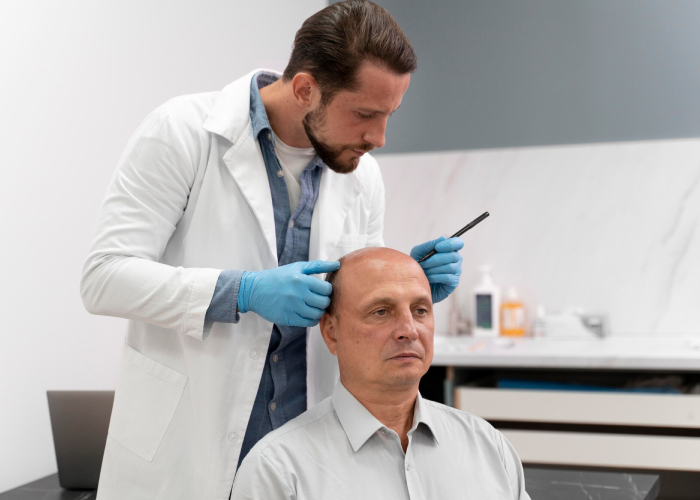
- Male pattern baldness (Norwood 3 Vertex, Norwood 4, 5, 6)
- Age-related thinning
- Hormonal changes
- Genetics
- Stress or poor lifestyle
- Previous trauma or surgery
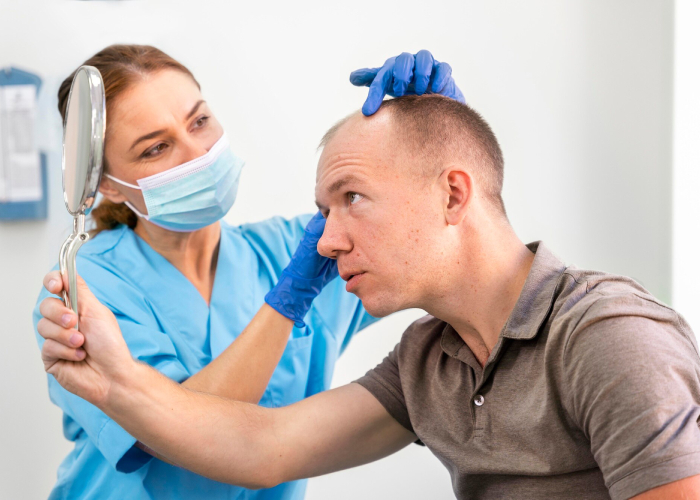
- More grafts due to circular, whorled design
- Correct angulation in 360-degree directions
- Higher density to match surrounding areas
- Strategic planning to ensure long-term sustainability
Using scalp analysis tools, we assess:
- Size of the bald area
- Density required
- Donor supply
- Growth pattern (whorl direction)
2. Donor Hair Extraction (FUE Method)
Follicles are extracted individually with micro punches (0.7–0.9 mm) ensuring minimal scarring and maximum survival rate.
3. Crown Design – Natural Whorl Creation
The crown naturally forms:
- Single or double whorl pattern
- Outward radial growth
- Multiple direction angles
4. Graft Implantation
Follicles are implanted:
- At precise angles
- In a natural spiral direction
- With optimal density
- Natural Whorl Pattern Recreation : The most critical aesthetic aspect of crown restoration.
- High Density & Coverage : Fills bald patches effectively and blends with surrounding hair.
- Permanent & Natural Results : Transplanted hair grows lifelong.
- No Linear Scar : FUE extraction ensures quick healing and minimal downtime.
- Improved Appearance & Confidence : Restores the fullness of the back scalp for a more youthful look.
- Crown thinning or bald patches
- Stable hair loss
- Strong donor density
- Realistic expectations
- Male pattern baldness progression
- Noticeable coverage by 6 months
- Full density in 10–12 months
- Crown results often look more dramatic due to improved volume
Is the procedure painful?
No. The procedure is performed under local anesthesia, ensuring you remain comfortable throughout. Most patients describe the sensation as mild pressure rather than pain.
How long does the procedure take?
Depending on the number of grafts required, the procedure typically lasts 6–8 hours. Larger sessions may be scheduled across two consecutive days to maintain graft viability and patient comfort.
When will I see results?
Transplanted hair sheds within 2–4 weeks-a normal part of the growth cycle. New growth begins around the 3rd month, with visible thickening by month 6.
Hair transplant results fully mature between 9–12 months with natural density and texture.
Are the results truly permanent?
Yes. Because transplanted follicles are DHT-resistant, they retain this property.
However, existing non-transplanted hair may continue thinning, which is why we may recommend PRP or GFC therapy alongside your hair transplant.
Will there be visible scarring?
FUE techniques leave tiny, dot-like scars in the donor area that are virtually undetectable, even with short hair. There is no linear scar, making this ideal for patients who prefer buzz cuts or shorter styles.
Can women undergo hair transplantation?
Absolutely. Female pattern hair loss requires a different diagnostic approach and our team is experienced in addressing diffuse thinning, receding hairlines and traction alopecia in women.
What is the recovery time?
Most patients resume non-strenuous work within 3–5 days. Strenuous exercise should be avoided for two weeks. Tiny crusts around grafts fall off naturally within 10–14 days.
How do I know if I'm a suitable candidate?
Ideal candidates have sufficient donor hair, realistic expectations and good general health.
During your consultation, we evaluate these factors thoroughly and discuss alternative or complementary options if hair transplant surgery isn't immediately suitable.


