





Hairline designing in India is where science converges with artistry. At FUE India, we do not believe in template hairlines — every design is an individualized architectural plan that accounts for your facial geometry, age, ethnicity, hair characteristics, and personal aesthetic goals. A hairline is not merely where hair begins; it is the frame of your face, the first feature observed, and the single most influential factor in whether a transplant appears natural or artificial.
Led by Dr. Vikas Chouhan, our hairline design protocol draws from classical facial proportion principles, contemporary aesthetic standards, and 15 years of surgical experience. We understand that a hairline must satisfy three criteria simultaneously: it must look natural today, remain appropriate as you age, and complement — not compete with — your other facial features.
The difference between a good transplant and an exceptional one often lies in millimeters. A hairline positioned too low creates a juvenile appearance that becomes incongruous with age. A hairline that is too straight appears artificial. A hairline with uniform density looks like a wig. Our approach avoids these pitfalls through meticulous measurement, artistic vision, and technical precision.
| Design Flaw | Why It Fails | Our Correction |
| Too low | Creates an unnatural, juvenile appearance; does not age well | We position based on forehead height, brow position, and age-appropriate recession |
| Too straight | Real hairlines have micro-irregularities; straight lines appear artificial | We incorporate soft zig-zag patterns and uneven borders |
| Too dense at front | Natural hairlines are softly feathered, not wall-like | We use single-hair grafts exclusively at the leading edge |
| Sharp, angular edges | Real hairlines transition gradually into temples | We create smooth, rounded temporal transitions |
| Mismatched with ethnicity | Hairline shape varies significantly across populations | We design for South Asian, Caucasian, or African hairline characteristics as appropriate |
At FUE India, hairline design is not a preliminary step — it is the foundation upon which the entire restoration is built.
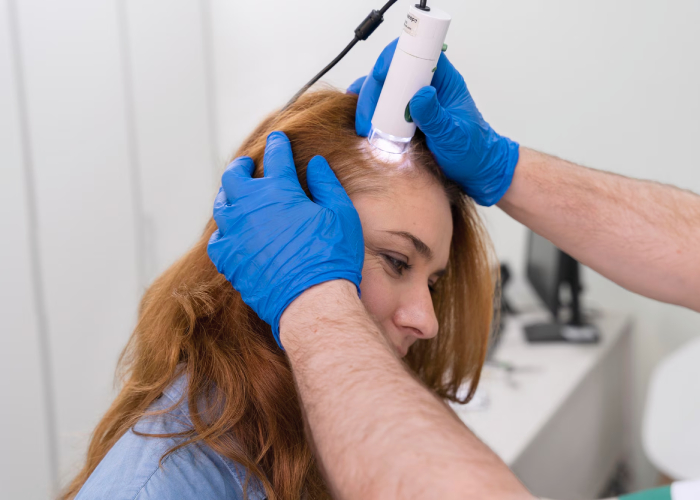
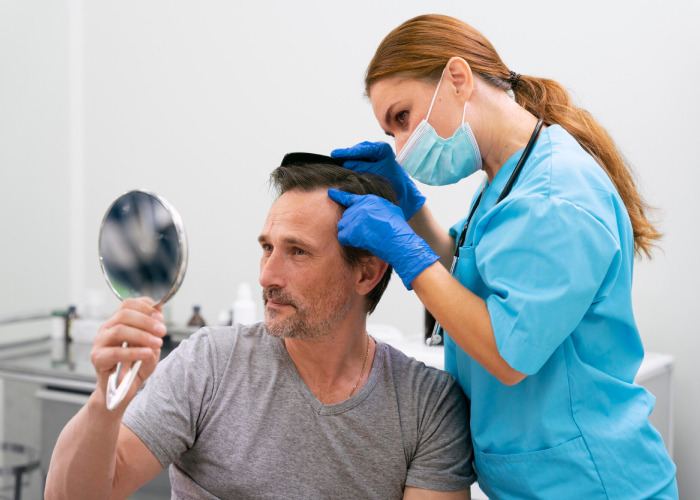
- Before any design is drawn, we conduct a comprehensive facial assessment: forehead height measured from glabella to existing hairline, facial width determining lateral extent, natural curvature informing restoration shape, symmetry evaluation using digital imaging, and brow position ensuring harmony with eyebrow arch and density.
- A 25-year-old receives a different design than a 45-year-old. We anticipate future hair loss patterns and create a hairline that will remain natural-looking for decades, not just months.
- Real hairlines are not geometrically perfect. We deliberately create micro-irregularities — tiny variations in the frontal edge, soft zig-zag patterns mimicking random growth, and uneven borders avoiding the “stamped” appearance of poor transplants.
- Each graft is placed with surgical precision: 10–15 degrees at the very front for natural forward flow, gradual angulation change toward temples and sides, and directional consistency ensuring all hairs point in the same natural growth direction.
- The front zone requires artistic subtlety: single-hair grafts exclusively at the leading edge for softness, multiple grafts positioned behind for volume and density, and transitional zones between hairline and mid-scalp for seamless blending.
| Type | Characteristics | Best For |
| Masculine Hairline | Strong, mature “M-shaped” pattern with slight temporal recession | Men seeking distinguished, age-appropriate framing |
| Feminine Hairline | Soft, curved, smooth edges with lower, less angular positioning | Women seeking youthful, delicate facial framing |
| Customized by Face Shape | Oval, round, square, long, heart-shaped adaptations | Patients seeking optimal facial harmony |
Each design is drawn directly on your skin with surgical markers and reviewed together before any procedure begins. You participate actively in the design process.
- Natural-Looking Results: Every hairline is created using artistic detailing and scientific precision — not templates or guesswork.
- Personalized Planning: You receive a custom blueprint unique to your facial architecture. No two hairlines at FUE India are identical.
- Long-Lasting Outcomes: Designed to age gracefully as your hair naturally evolves. What looks appropriate at 30 should still look appropriate at 50.
- Enhanced Symmetry: Improves the balance and contour of your face, often creating the illusion of better proportion even before grafts mature.
- Confidence Restoration: A refined, natural hairline dramatically improves appearance and self-image — the primary motivation for most patients seeking hair transplant in India.
Hairline design is essential for:
- Individuals undergoing FUE hair transplant who want optimal aesthetic outcomes
- Those with irregular, receding, or asymmetric hairlines seeking restoration
- Patients requiring correction of a previous poor transplant with an unnatural or outdated hairline
- Men and women wanting a more aesthetic, balanced facial frame
- Beard hair transplant patients requiring coordinated facial hairline design
- Eyebrow transplant candidates where brow and hairline proportions must harmonize
| Timeline | Milestone |
| Day of procedure | Hairline is drawn, approved, and implanted with precision |
| Weeks 2–4 | Transplanted hair enters shedding phase (shock loss) — normal |
| Months 3–4 | Fine new growth emerges along the designed hairline |
| Months 6–8 | Visible thickening; hairline shape becomes apparent |
| Months 9–12 | Final maturity — natural, soft, age-appropriate hairline achieved |
The end result is a hairline that appears to have always been there — not one that was surgically created.
<
Grade 2 Baldness Hair Transplant Surgery
<
Grade 7 Hair Transplant Treatment and Hairline Marking
<
Is hairline designing painful?
How long does hairline design take?
Can a bad hairline from a previous transplant be fixed?
Will my new hairline look natural as I age?
How is the hairline position determined?
Can women benefit from hairline designing?
What if I want a very low hairline?
How much does hairline designing cost?
Do you design hairlines for beard and eyebrow transplants?
What makes FUE India's hairline design different?
Our combination of classical proportion analysis, age-anticipatory planning, and patient-collaborative approval ensures hairlines that are uniquely yours — not template-based or one-size-fits-all.
3


