





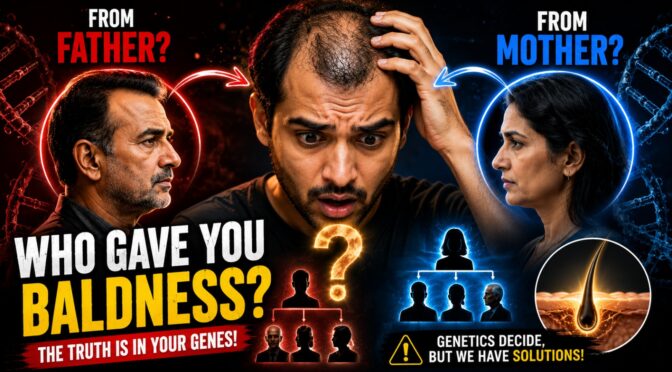
Many people look in the mirror every day and worry about their hair.
They see their hair thinning out or notice their hairline moving back. This makes them ask a big question: is baldness hereditary from mother or father?
Hair loss can make people feel sad or stressed. But you do not have to face this alone.
At FUE India, we know everything about hair and scalp health. Our clinic is the premier destination for hair restoration because we help people get their confidence back.
We have top doctors who know how to fix hair problems. We want to help you learn why hair loss happens in families.
When you know the facts, you can make the best choices for your head. Let us look at how hair genes work and how you can get a full head of hair again.
The Short Answer: Is Baldness Hereditary From Mother Or Father?
People often argue about where hair loss comes from. You might hear people say that it is hair genetics from mom or dad. For a very long time, an old story said that baldness only comes from your mother’s side of the family. People would look at their mother’s father to see if they would lose hair. But that old story is not true. The short answer is that baldness comes from both sides of your family tree. You get genes from your mother and your father. Both sides pass down the traits that cause hair to fall out.
If you have bald relatives on either side, you have a chance of losing hair. At FUE India, our top doctors look at your whole family history to help you get a natural result.
The Mother’s Role: The X Chromosome Connection
Your mother plays a special part in hair loss because of how babies get DNA from their parents.
The AR Gene and Hair Follicle Sensitivity
Inside your body, you have tiny parts called chromosomes.
Girls have two X chromosomes, while boys have one X chromosome and one Y chromosome. Boys get their X chromosome from their mother.
This matters because an important gene lives on the X chromosome. This gene is called the AR gene, or the Androgen Receptor gene. The AR gene tells your hair roots how to act. If your mother passes down a strong AR gene, your hair roots will be sensitive to body chemicals. This sensitivity causes the hair to grow thin and weak over time.
Why Everyone Blames the Maternal Grandfather
Because the AR gene is on the X chromosome, people always look at the maternal grandfather. That is your mother’s dad. If your mother’s dad is bald, it means he had that hair loss gene on his X chromosome. He passed that chromosome down to your mother.
Then, your mother passed it to you. That is why people blame the mother’s side for a bald head. It is a real path that genes take, but it is just one piece of a large puzzle.
The Father’s Role: Paternal Genetics and Hair Loss
Your father’s side of the family matters just as much as the mother’s side when looking at hair.
Autosomal DNA and Shared Genetic Traits
Scientists know that hair loss is not just about the X chromosome. There are many other genes involved in baldness. These genes are found on chromosomes called autosomes.
Both men and women have these autosomes and pass them down to their kids. This means you can get hair loss genes directly from your father’s side too.
If your father is bald, or if his brothers lost their hair, those genes can come to you. Hair loss is a mix of genes from both parents.
If Your Dad is Bald, Will You Be Too?
If your dad is bald, you have a higher chance of losing your hair. But it is not a 100% guarantee. Genes work like a game of chance. You might inherit the hair loss genes, or you might get the genes for thick hair instead. If your dad lost his hair early, you should watch your hair closely. Catching hair loss early makes it easier to fix. At FUE India, we help young men check their hair lines to see if they have inherited these traits.
The Role of Hormones: Understanding DHT (Dihydrotestosterone)
Genes do not turn off hair growth alone. They use tools inside your body to make it happen.
How DHT Shrinks Hair Follicles over Time
If you have the hair loss gene, your hair roots are sensitive to DHT. Think of DHT like a bully on your scalp. DHT attaches to the hair roots and squeezes them slowly.
It makes the hair roots smaller and smaller over time. When the roots shrink, the hair grows back thinner and shorter each time.
Soon, the thick hair turns into tiny, soft hair. After a long time, the root stops making hair. This is how bald spots form on top of your head.
Beyond Genetics: Other Factors That Trigger Hair Loss
While genes are the biggest reason for baldness, other things in your life can make hair fall out faster.
Stress and Telogen Effluvium
High stress is bad for your hair roots. When you are very stressed, your body stops sending energy to things that are not needed to stay alive, like your hair.
This can cause a condition called Telogen Effluvium. This condition forces many hair roots to go to sleep at the same time. A few months after a stressful event, you might see hair fall out in the shower. This can happen from a big exam, a loss, or an illness.
Diet, Nutrition, and Vitamin Deficiencies
Your hair needs good food to grow strong. If you do not eat balanced meals, your hair roots will starve. A lack of iron, zinc, or Vitamin D can cause hair loss.
People often ask how to stop genetic hair loss naturally. Eating a diet full of proteins, green vegetables, and nuts is a good start.
Good food keeps your scalp healthy, but it cannot change your DNA. A good diet helps, but it will not stop genetic baldness completely.
Medical Conditions and Medications
Certain health problems can cause your hair to thin out.
For example, thyroid problems can change how your body grows hair. Also, some strong medicines can cause hair fall as a side effect. This includes medicines for high blood pressure or heart issues. If you think your medicine is making your hair fall out, talk to your doctor. Never stop taking your medicine without asking a medical professional first.
Early Signs of Hereditary Baldness to Watch Out For
It is important to know when hair loss is starting so you can protect your hair early.
Receding Hairline and Thinning Crown
For most men, genetic hair loss starts in two common places.
First, you might see a receding hairline. This means the hair on your forehead moves backward, forming the shape of the letter M.
Second, you might notice a thinning crown. The crown is the top or back part of your head. You might notice that you can see your scalp more easily under bright lights.
If you see these changes, your hair genes are active.
The Norwood Scale For Male Pattern Baldness
Doctors use a special chart to track hair loss. This chart is called the Norwood Scale, and it has seven stages. Stage 1 is a full head of hair with no loss.
Stage 2 shows a tiny bit of hair loss near the temples. As the numbers go up, the hair loss gets larger. By Stage 7, most of the hair on top is gone. Our top doctors at FUE India use this scale to see your stage and create the perfect plan for your hair restoration.
Effective Treatments For Hereditary Hair Loss
If you have genetic hair loss, you do not have to lose hope. There are real solutions that work safely.
FDA-Approved Medications (Minoxidil and Finasteride)
There are two main medicines that doctors recommend for hair loss.
The first is Minoxidil. This is a liquid or foam that you rub onto your scalp every day. It helps bring more blood flow and food to your hair roots.
The second is Finasteride. This is a small pill that you take once a day. It works by lowering the amount of DHT in your body.
These medicines work well, but you must keep using them to keep your results.
Hair Transplant Surgery
If you want a permanent fix, hair transplant surgery is the best path.
FUE India is known for providing the Best Hair Transplant services.
Our top doctors use a modern method called Follicular Unit Extraction, or FUE. In this process, we take healthy hair roots from the back of your head where hair never falls out.
Then, we place them carefully into the bald areas on top. The process is completely safe and painless. Once the new hair grows, it gives you a beautiful, natural result.
Best of all, this new hair provides Growth for Lifetime. It will never fall out because these roots do not care about DHT.
Lifestyle and Cosmetic Options
Many people look for ways on how to stop genetic hair loss naturally. You can use natural oils like rosemary oil to massage your scalp.
Massaging helps blood flow straight to the roots. You can also use special shampoos that make your hair look thicker.
While these options are great for keeping your scalp clean, they cannot fix damaged hair roots or alter your family genes. For a real change, professional medical help is needed.
FAQ’s:
Does the baldness gene skip a generation?
Many people wonder, does baldness skip a generation? The answer is yes, it can happen.
Because genetics are complex, you might not get the active hair loss genes that your parents have. The genes can stay hidden inside your DNA without causing you to lose hair. Then, you might pass those hidden genes to your own children, and they might lose their hair. This makes it look like the trait skipped a generation, even though the gene was just sleeping.
Can I still go bald if nobody in my family is bald?
Yes, you can still lose your hair even if your parents have full heads of hair. It is rare, but it happens. You might have hidden hair loss genes from many generations ago that suddenly became active in you. Also, your hair loss could be caused by other things like high stress or a poor diet. If you notice your hair falling out, come to FUE India for a free consultation. Our top doctors will find the exact cause.
At what age does hereditary baldness usually start?
Hereditary baldness can start at almost any age after you pass puberty. Some young men see a receding hairline in their late teens or early twenties.
For other people, it does not start until their thirties or forties. The exact age depends on how strong your family genes are and your body’s hormone levels.
Is there any way to completely prevent hereditary baldness?
You cannot change your DNA, so you cannot completely prevent the genes from being inside your body. However, you can stop those genes from destroying your hair roots.
If you start using the right treatments early enough, you can keep your hair for a long time. Talking to the experts at FUE India early is the best way to protect your scalp.
Does wearing hats accelerate hereditary hair loss?
No, wearing hats does not cause you to lose your hair faster. This is an old myth.
Hats do not pull your hair roots out, and they do not stop your scalp from breathing. Your hair roots get their oxygen and nutrients from the blood flow inside your body, not from the air outside. So, you can wear your favourite hat as much as you want without fear.
Conclusion
Losing your hair can feel like a tough problem, but it has a clear fix.
The big question of whether baldness is hereditary from mother or father shows us that our family tree plays a major role in how we look. But you do not have to accept hair loss as your only option.
FUE India is here to help you get your hair back with confidence.
We provide the Best Hair Transplant with a completely safe process that gives you a beautiful, Natural Result. Our top doctors make sure you get Growth for Lifetime. Do not wait for your hair to disappear completely. Contact FUE India today to book your Free Consultation and start your path to a full head of hair.


